
This website is continuously under development. Feedback is always appreciated!

B.C. Muons in Classrooms: Particle Physics Outreach
banner

The MusIC project uses Cosmic Watches, an open source muon detector developed by Spencer Axani. Learn all about his detector and make one for yourself here.

Muons in Classrooms (μsIC or MusIC) is both an outreach initiative and a physics experiment. When you’re involved, our scientists will visit your classroom to introduce particle detection and particle physics in BC. Together, we will set up a Cosmic Watch station and connect you to the MusIC detector network. We will demonstrate how to access and understand detector data, and you will have ongoing access to all data from the network and your detector.

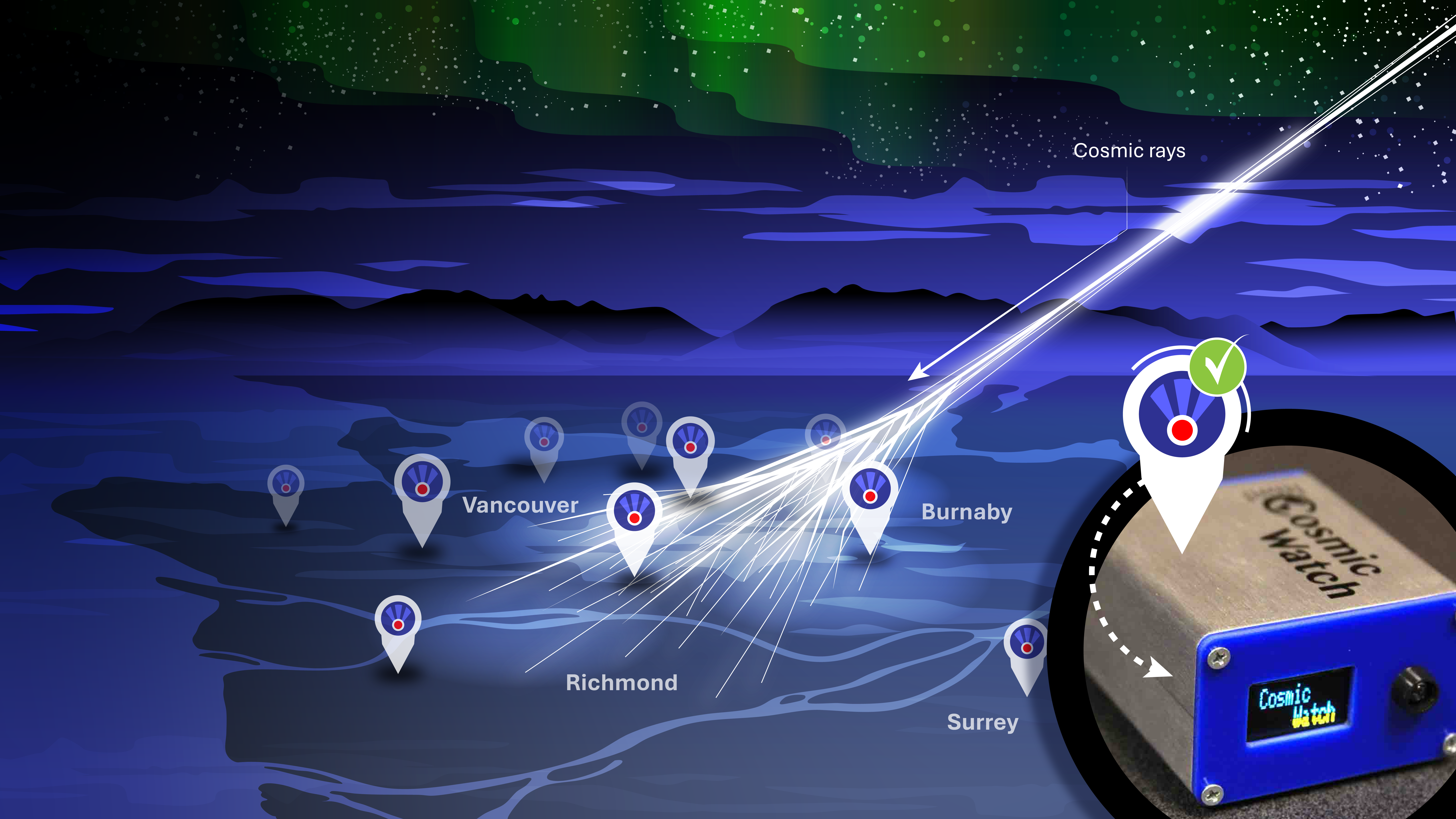
MusIC is an experiment which is currently growing, with the goal of building a network of detectors in classrooms across BC to observe individual muons, airshowers, and connect students with an accessible and engaging particle physics project.

Explore this site for more info on the science and people behind the project!

Contact us to get involved, ask a question, or schedule a classroom visit:

bc.muons.in.classrooms@gmail.com

Active Cosmic Watch Detectors in B.C.

Explore the map to find your own registered detector! Use your mouse to drag and zoom, or interact via the buttons on the upper right of the figure. Hover over a detector to read out its precise location and ID tag.

Pages and Posts

About Us
The MusIC Team Dr. Emily Filmer (TRIUMF) Emily moved to Vancouver in 2024 after completing her PhD in Adelaide, South Australia. During that time, she participated in two national road trips taking quantum and dark matter to over twenty remote and regional schools. She is keen to bring her love of science and science education to BC schools with the Cosmic Watch Project.
Data
Database Access and Analysis On this page, you can upload detector data to the MusIC database using your user credentials provided during the outreach session. Or, without needing credentials, you can download anyone’s detector data to use to create your own analysis. You can also select a detector and quickly view a snapshot of the hits it has recorded with our pre-made figures.
FAQ
Frequently Asked Questions How do I get MusIC into my classroom? Send us an email! We're happy to hear from you, and we'll answer any further questions you might have and schedule a time to visit. At the moment, we're only able to do 1-2 classroom visits per month, so reaching out in advance of your desired visit date is recommended.
Muons, Airshowers, and Particle Detectors
Muons, Airshowers, and Particle Detectors A muon is an elementary particle. It has the same negative charge as an electron, but is roughly 207 times heavier. Because of its high mass, a muon is very unstable, and within a few microseconds will decay into electrons and neutrinos.
The Cosmic Watch Detector
The information on this page is paraphrased/summarized from Spencer Axani’s Detector Instruction Manual, in which you can find many more details and useful information. Detector Anatomy Screen: Live updating information about recorded hits to detector. Reset button: clears detector memory to begin recording data again. Coincident LED: lights up when more than one detector is in “coincidence mode” and both detectors record a hit. Trigger LED: lights up when a hit is detected. Display Screen The screen shows a snapshot of the current data-taking period.